Forestry program adapts to the changing times … and the changing climate
Students in Forest and Natural Resource Management integrate classroom learning with extensive field experiences to create adaptive — and constantly evolving — forest management strategies.


Key takeaways:
- Students in the Forest and Natural Resource Management major are poised for rewarding careers in forestry, natural resources, conservation, parks and recreation, urban green space and more.
- The various fields within forestry and natural resources are inherently adaptive and constantly evolving. Environments and conditions change — often affected by climate change — and therefore the science is dynamic.
Today’s University of Minnesota students see a chance to help with actionable solutions and make a difference in the world.
Sitting in her office in Green Hall on the St. Paul campus, home to the University of Minnesota’s Department of Forestry, Linda Nagel slides a diagram across the table that looks vaguely like a tree. It’s a page from the Society of American Foresters’ College Guide listing possible career paths for students interested in forestry and natural resources.
From a forest economist to a park ranger, an extension agent to a wood products engineer, a soil scientist to a smokejumper, the list numbers 60 but seems endless.
For forestry students at the University of Minnesota, this banquet of career options is all on the table. While some of the learning takes place via textbooks and in the classroom, much of it is out in the field and is further advanced by completing capstone projects and developing forest management plans, says Nagel, head of the Department of Forest Resources and interim dean of the College of Food, Agricultural and Natural Resource Sciences (CFANS).
“Forestry is an excellent profession to test new things because it’s inherently adaptive,” she says. “You’re stopping and asking questions and reflecting and collecting data, which then informs what you do next.
“It’s science-driven but it’s values-driven as well. It’s a very interesting mix.”

Opportunities across a great expanse
The Forest and Natural Resource Management (FNRM) major in CFANS is the only fully accredited four-year program in the state and one of the only programs housed in an urban environment, according to Marcella Windmuller-Campione, associate professor and director of undergraduate studies for the major.
The major offers three distinct paths for students to pursue their passions: Forest Ecosystem Management & Conservation, Park & Protected Area Management, and Urban & Community Forestry.
Classes are taught by faculty who got into the field because they enjoy doing the research and the fieldwork. “We want to be teaching how we learned and how we learn,” Windmuller-Campione says. “There are some [aspects] that can really benefit from having a lecture or having indoor activities. But a lot of the pieces really come alive when we are outside, when we’re doing field trips.”
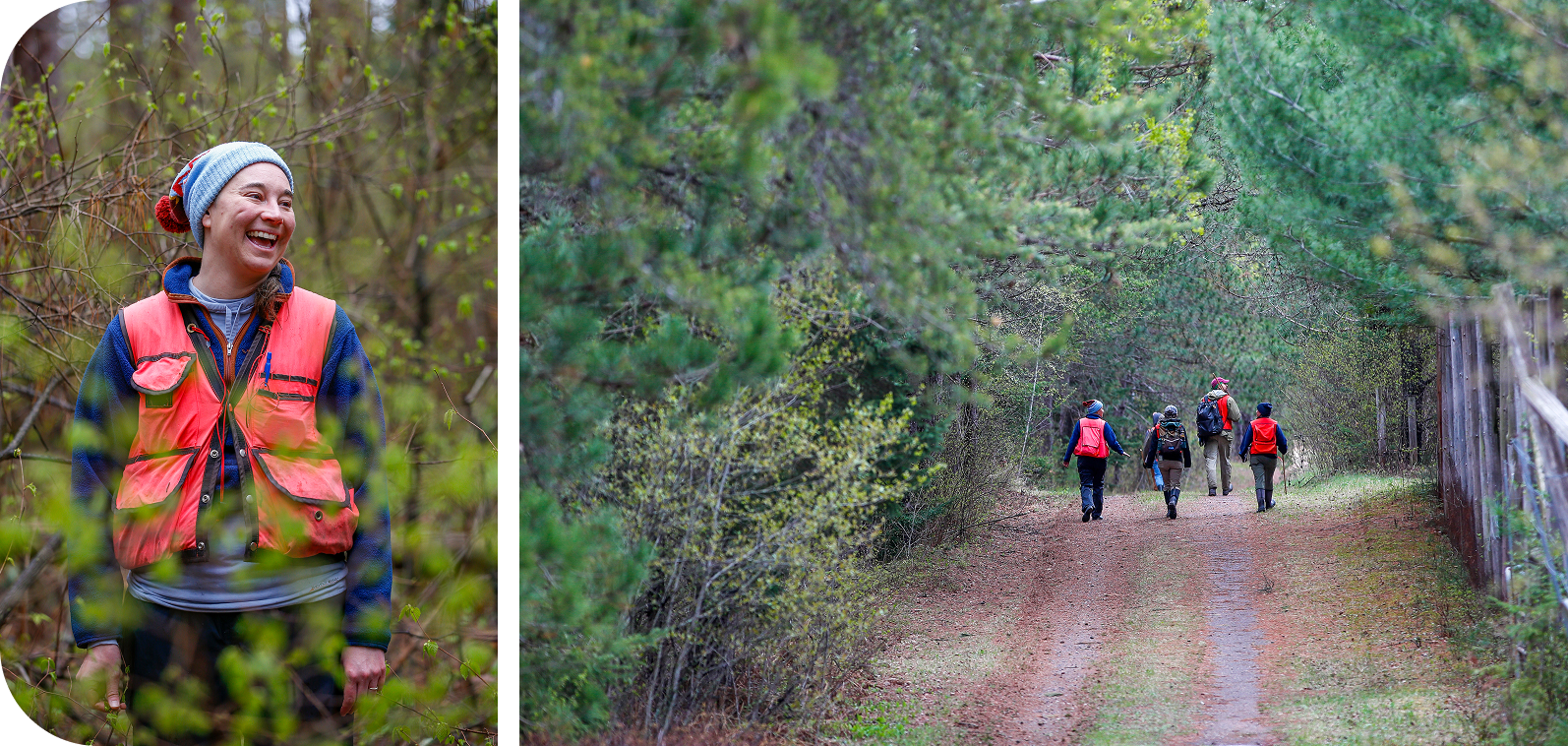
Those can include longer field sessions at the Cloquet Forestry Center or the Hubachek Wilderness Research Center, and most classes have some kind of field component.
Windmuller-Campione says students who complete the program are poised to work anywhere from a large city to a smaller destination city (like Duluth or Rochester), or in more rural settings — like in the Superior National Forest, the Boundary Waters Canoe Area Wilderness or for the Minnesota DNR. There is no shortage of land to manage; Minnesota has 18 million acres of forest land.
“So you can kind of have your cake and eat it too,” she says. “Which is a really unique situation for a forestry school to be able to provide.”

‘There’s nothing like learning outside’
Given that analogy, AJ Jensen has been sampling a lot of cake. Jensen transferred from Normandale Community College to the Forest and Natural Resource Management program, and from the moment she arrived, she immersed herself in all things forestry.
“Because I was so excited to be here, I just started showing up to everything and asking people questions,” she says. “And from that, there’s been so many neat opportunities I’ve gotten to experience.”


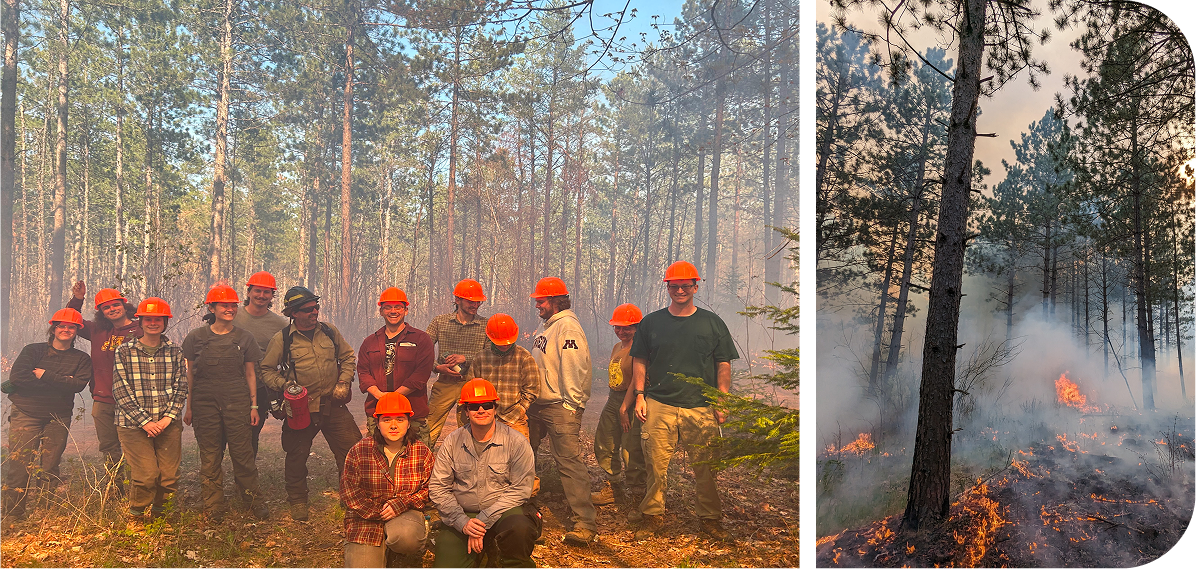
Over a spring break, Jensen earned her Basic Wildland Firefighter certification. She’s had internships including for the Urban Forestry Outreach and Research Lab, through which she became a certified tree inspector. She’s the treasurer of the Forestry Club, the vice president of the Tree Ascension Club and was chosen to attend a national conference through the Society of American Foresters.
Jensen attended the introductory Cloquet field course her first summer, a recommendation for transfer students. “That course definitely solidified that I was in the right place,” she says. “There’s nothing like learning outside. It’s inherently tactile. You can read a plant book, but until you see it in front of you it doesn’t really stick.”
Her career preferences are constantly evolving as she experiences new things with the program. “I have done a lot of tree climbing and have considered being an arborist,” she says. But “right now, my career dream is to be a forest health specialist for the state, because I’m really interested in forest pathology.”

Adaptive forest management: Turning evolving science into real-time solutions
The various fields enveloped within forestry and natural resources are constantly evolving. Environments and conditions change — often affected by climate change — and therefore the science is dynamic.

Nagel says that figuring out how forests respond to change is essential to determining how to adapt practices in the future. To that end, faculty and researchers study a spectrum of conditions and responses in an area. Then, depending on forest management objectives, they might develop an adaptive silviculture “prescription.”
“What we’re doing more actively is assessing: is this ecosystem type vulnerable to anticipated changes to climate — increasing temperature, shorter growing season, more extreme conditions, increases in ice storms?” Nagel says. “Are the ecosystems highly vulnerable to drought, and then to insects and disease? Then, how might we shift our approach to forest management, given those known vulnerabilities?”
“We have textbooks that we teach out of, but these are contemporary practices that we’re learning in real time, as we go.”
Listen to Linda Nagel describe how the University is driving forestry research and what that means for students.

A chance to make a real difference in the world
Windmuller-Campione notes that young people of all ages, including those just entering college, have grown up under the specter of climate change as a real if not ominous threat, which can lead to anxiety and a feeling of being overwhelmed.
But they also see a path to making meaningful change, as confirmed by a recent CFANS Insights Survey. Among its findings: Nearly 90 percent of U.S. teens say that higher education plays a critical role in helping society address major challenges such as food insecurity and climate change. That’s clearly motivating a good number of students in forestry and other programs at the University of Minnesota’s campuses.
A sense of altruism — and a desire to make change — is what’s driving Jensen.
“A huge part of it is just wanting to make the world a better place. I feel very naturally curious about the natural world … and it feels like that’s where I can contribute,” she says. “I think it’s really easy to be a steward of the environment or a student in environmental science and feel doomed sometimes. But on the other side of the coin, the more you know about it, the more change you can [create].”

“Students come away from classes being able to see actionable solutions,” says Windmuller-Campione. “You can make a difference, and there are real opportunities to be doing this on the ground.
Nagel adds that in forestry, preservation means many things.
“Students want to address global challenges. They care deeply about the environment,” she says. “And it’s not just preserving something. What we teach students is how to steward things forward. We have to use natural resources; we can’t live without using natural resources. So we are helping students gain the skills to be able to make a positive difference in how we manage those natural resources.
“So yes, I think it is an exciting place for students to come and study.”

Support students majoring in forest and natural resource management, urban and community forestry, and recreation resource management in the Department of Forest Resources at the University of Minnesota Twin Cities
