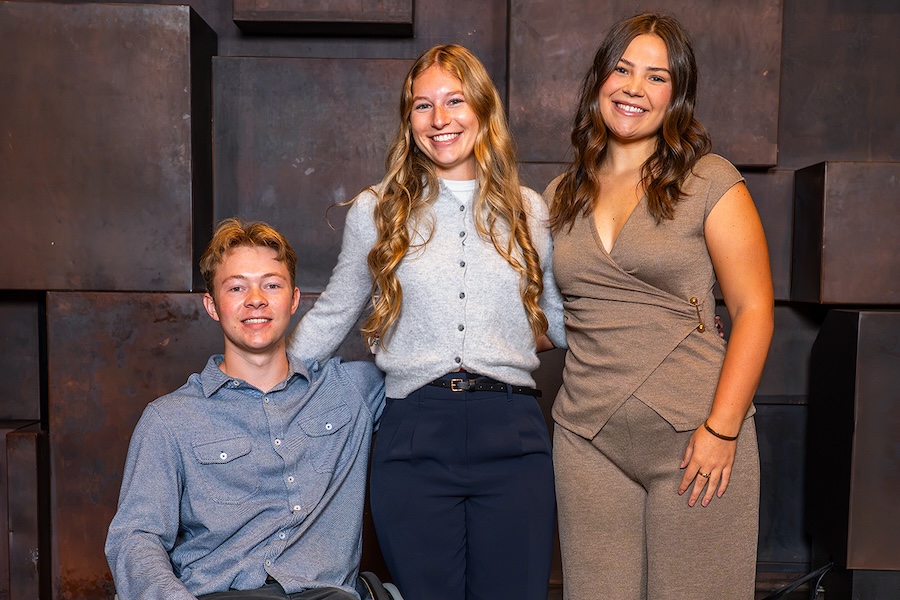
For many, managing one startup would be overwhelming. But for Isak Hedeen, two startups are driving his innovation.
Hedeen, who graduated in May, recently was named the University of Minnesota’s Student Entrepreneur of the Year, and he made the most of his time at the University of Minnesota. Hedeen helped design and found two distinct ventures: AVNT, starting with an ergonomic wheelchair push rim for people with impaired hand function, and later expanding into a broader line of accessible fitness and mobility equipment, and Merra, a safety alarm for women designed like a discreet bag accessory.
For Hedeen, the idea of becoming an entrepreneur was paved early on. Growing up in the western suburbs of the Twin Cities and graduating from Orono High School in 2020, he was inspired by the examples around him.
“My dad and uncle are entrepreneurs,” Hedeen says. “So seeing them run their own business really made me believe I can do it as well. I think a lot of people who are entrepreneurs had someone in their life that they could see, so this is achievable. That was a big motivation for me.”
Hedeen originally planned to move to San Diego for school after high school, but his life changed dramatically in August 2020 when an injury left him paralyzed. After a year-and-a-half gap in schooling, he decided to stay close to home and enroll at the University of Minnesota.
When it came time to decide what to study, Hedeen remembered a conversation he had with a high school art teacher who mentioned the University’s Product Design program.
“That kind of clicked in my head,” Hedeen says. “I thought I wanted to study engineering, but after looking into product design, I realized that was a lot more what I thought engineering would be like. Product design was more up my alley, so then I joined it, and I absolutely loved it.”
Finding the spark in the classroom
Hedeen’s entrepreneurial journey took off during his senior year when he enrolled in the University’s unique Entrepreneurship in Action course. Offered through Minnesota Carlson, it’s a two-semester experiential learning class where undergraduate students aim to launch and begin operating a real startup. Throughout the year, students receive support from Minnesota Carlson faculty, experienced entrepreneurs, and a network of professional service providers — including attorneys and bankers — while also having access to up to $15,000 in funding and dedicated workspace within the school, creating a fully immersive startup experience.
Through the course and campus resources such as the Toaster Innovation Hub and Health Sciences Library Makerspace, Hedeen cofounded Merra along with three other students.
Traditional self-defense alarms are usually made of plain plastic and end up buried at the bottom of a bag where they are hard to reach in an emergency. Merra looked to address this issue by styling the alarm to look like a fashion accessory, keeping it accessible and in the open so users can quickly activate it if needed. Hedeen led product development of the prototype.
While working with Merra, Hedeen is also managing a second startup, which he began through another start-up class called “Start up: Customer Development and Testing” and the University's “MVP Challenge.” Drawing from his daily life, he wanted to address physical challenges for wheelchair users through AVNT. Standard aluminum wheelchair push rims are a uniform three-quarters of an inch thick tube and offer no cushion or grip, which can lead to injuries such as carpal tunnel syndrome over time. Using his 3-D printer and design skills, Hedeen engineered a practical alternative.
AVNT uses an interchangeable silicone grip that snaps into his custom wheelchair rims. The silicone layer cushions the hands, removes sharp pressure points and adds traction for propulsion. Because the components are removable, they can be swapped for different shapes and textures to suit individual users without replacing the entire rim.
Expanding on this work, Hedeen also started development on an adaptive exercise station for wheelchair users through his product design capstone.
Navigating MN Cup and beyond

Juggling two major startups simultaneously alongside a part-time engineering role in medical device manufacturing at ProMed is a staggering feat, yet Hedeen has managed to keep both projects on track.
Both AVNT and Merra were entered into the Minnesota Cup, the state’s largest startup competition, hosted by the Gary S. Holmes Center for Entrepreneurship. Both ventures advanced to the semifinals, with Merra ultimately taking second place and being named the Student Division runner-up.
Along the way, Hedeen received mentorship and business strategy advice to move his products forward.
“It was a little stressful during the semifinal round because I had both projects in it,” Hedeen says. “Doing everything twice was just a lot on my plate. But the mentorship was really helpful, and I learned a lot through all of the feedback you get."
The experience helped Hedeen establish a concrete structure for his ventures. Merra is now preparing for a Kickstarter launch to support its first production run, while AVNT is applying for an SBIR grant to help fund further development and testing. Beyond his own companies, Hedeen has become a resource for fellow students, supporting them as they navigate product development challenges.
Hedeen credits both the University’s Product Design program and its business resources for giving him the ability to take his ideas from concept to product.
“Product design and entrepreneurship go together like bread and butter,” Hedeen says. “Product design has taught and shown me the beginning processes of finding a problem, doing the research, ideating solutions, building a prototype, and testing it. And then the entrepreneurship program is, okay, now how do we validate that? How do we market this? How do we set up the actual business structure?”
- Categories:
- Business and Management
- Entrepreneurship


